
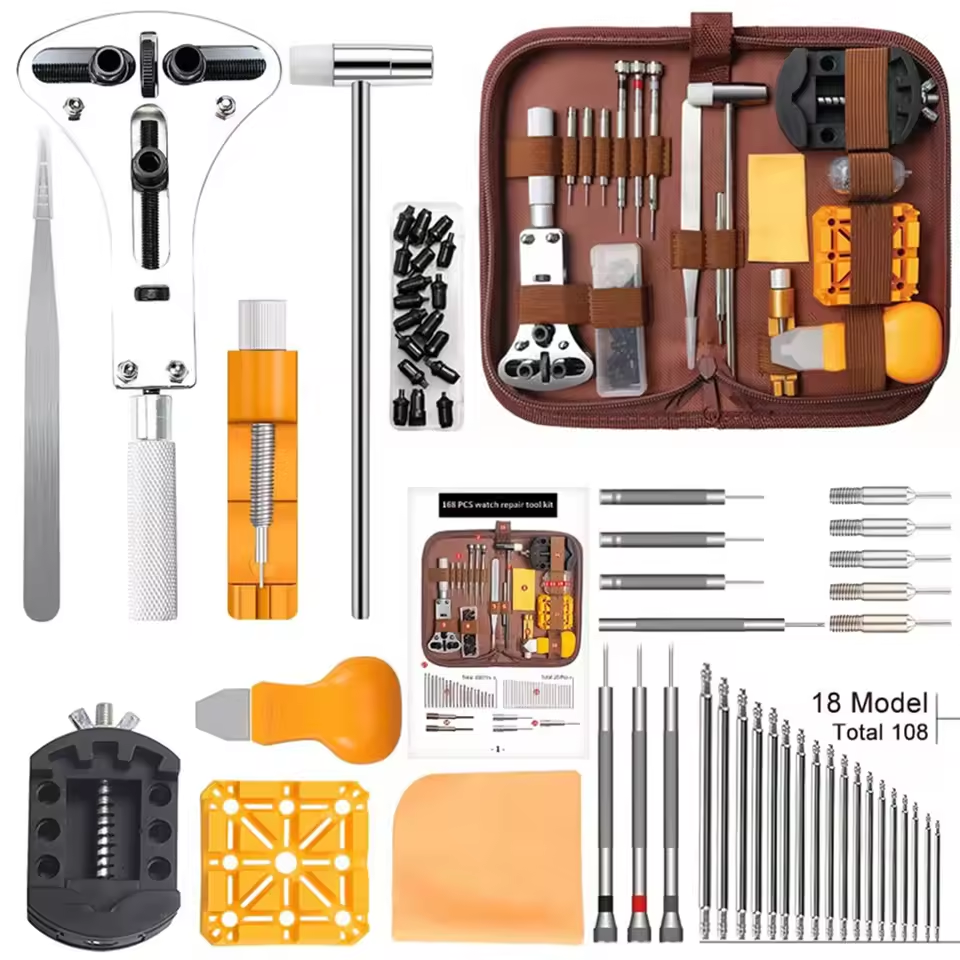
Beginner watch repair tool shopping can go wrong in two opposite ways. Some people buy the cheapest kit they can find and then fight slipping screwdrivers, rough tweezers and unstable case support. Others try to buy every premium tool at once before they know which repairs they will actually do.
The better approach is to spend first on the tools that protect the watch, protect small parts and make repeat work more controlled. Budget tools can still be useful, but they should sit in the lower-risk parts of the bench.
Start with the repairs you actually plan to do
A battery change, bracelet resize, hand setting job and movement swap all need different tools. Before buying a large kit, list the next three jobs you want to attempt. If most of them are battery changes and bracelet adjustments, a broad starter kit may be enough to learn the basics. If you want to work around hands, dials and mechanical movements, prioritise cleaner handling tools earlier.
For a broad starting point, WRT’s watch repair tool kit guide explains the common contents of beginner kits. This article is about the order of spending once you know the type of work you want to do.
Spend first on screwdrivers
Screwdrivers are one of the first places where quality matters. A poor blade that is too soft, too thick or badly shaped can slip out of a screw slot and leave marks quickly. Bracelet screws, case screws and movement screws are small enough that a slightly wrong fit can create a visible problem.
A beginner does not need a huge screwdriver drawer on day one. A controlled set with clean tips is more useful than many loose drivers of uncertain size. The watch screwdriver range is the right place to compare options, and the recent guide on watch screwdriver sizing explains how blade fit changes by task.
Budget compromise: if you are only resizing inexpensive bracelets, a simple screwdriver may be acceptable while you learn. Do not use a rough or slipping driver on a customer’s watch, a valuable case screw or a movement screw.
Spend early on tweezers that match the task
Tweezers are not exciting, but they decide how confidently you can handle screws, springs, hands, stems and small parts. Rough tips can launch parts or mark soft surfaces. Very fine tips can be useful, but they are also easy to damage if they become the only pair on the bench.
It is sensible to own at least one good pair for clean handling and one less precious pair for rougher jobs. Browse watch repair tweezers by task, then use the guide on choosing steel, plastic and anti-static tweezers to decide what belongs on your bench.
Budget compromise: basic tweezers can be used for packaging, straps and non-critical handling. Keep your cleanest pair away from scraping, bending and force work.
Do not underbuy movement support
A movement holder is easy to overlook because it does not cut, press or open anything. Its job is quieter: it keeps the movement stable while your hands are doing delicate work. That stability matters when you are removing hands, setting hands, fitting stems, checking keyless work or handling a loose movement outside the case.
If the movement rocks or twists, you are more likely to slip. The movement holder category covers the common holder styles, and the existing article on why movement holders matter at the bench is worth reading before working outside a case.
Budget compromise: a simple adjustable holder can be a good first purchase for practice movements. Move up when the holder no longer supports the movements you work on securely.
Buy enough magnification before buying more tools
Many beginner mistakes come from poor visibility, not poor technique. If you cannot see whether a screwdriver blade fits, whether a hand is level or whether dust is sitting near the dial, more tools will not fix the problem.
Start with magnification that is comfortable enough to use for the whole task. WRT’s magnification and loupe range gives you a place to compare options, while the watchmaker loupe magnification guide explains why stronger is not always better.
Budget compromise: an affordable loupe can be fine for battery changes and inspection. For hand, dial and movement work, comfort and clarity become much more important.
Where a budget kit still makes sense
Large beginner kits are useful when they let you try several simple jobs without buying each tool separately. Case openers, spring bar tools, pin pushers, simple holders and small accessories can be perfectly acceptable for learning on inexpensive watches.
The risk is treating a kit as permission to attempt every job immediately. A kit can help you remove a strap, inspect a case back or practise on a spare watch. It does not automatically make hand setting, pressure confidence or movement servicing low risk.
If you want a broad starter option, compare the 149 piece watch repair tool set and the Ultimate Starter Watch Repair Bundle. Choose based on the jobs you plan to do first, not on the highest piece count.
Where beginners should slow down
Any tool that can mark a dial, bend a hand, scar a case back or compromise water resistance deserves extra care. Case knives, Jaxa style openers, hand levers, presses and gasket work are not impossible for beginners, but they punish rushing.
Practise on low-value watches first. Use a case cushion. Keep the bench clean. Stop when a tool slips instead of adding more force. If a screw, case back or hand will not move cleanly, the next step is usually better support, better fit or more information, not more pressure.
A simple buying order
For most beginners, the sensible order is clear visibility, stable support, screwdrivers that fit, tweezers that hold cleanly, then task-specific tools for the repairs you actually plan to do. A starter kit can sit around that core, but it should not replace the few tools that protect the watch from avoidable marks.
Spend where the tool touches delicate parts. Save where the job is low risk, replaceable and easy to practise. That balance builds a bench that is useful now and still worth keeping as your repair work gets more serious.


