
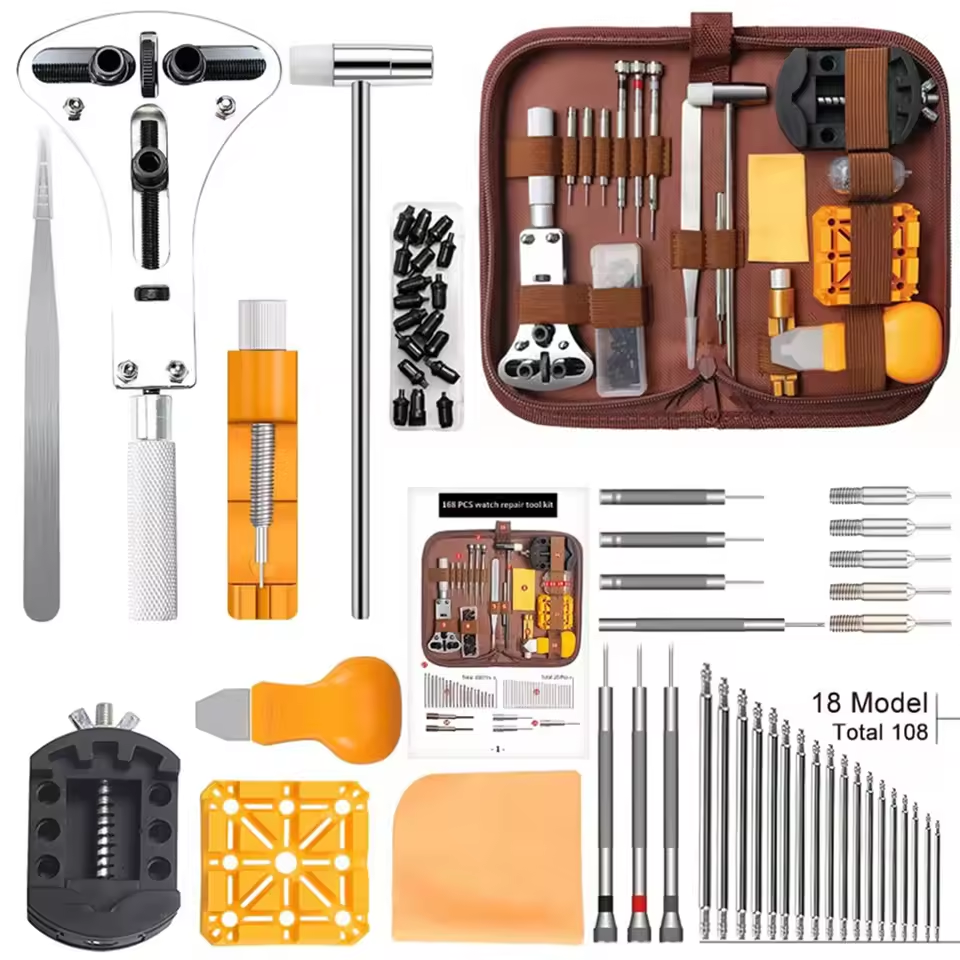
A basic watch repair kit is usually built for jobs around the outside of the watch. It helps with case backs, bracelets, spring bars, batteries, straps and simple handling. A watch servicing kit is different. It starts to support work inside a mechanical movement, where dust, oil quantity, hand clearance and part control matter much more.
That difference is important for beginners because the words sound similar. A large kit can look complete, but it may still be a repair kit rather than a servicing setup. Before you remove hands, lift a dial or open a movement, the bench needs to be cleaner, steadier and more controlled.
What a repair kit is normally for
A repair kit is best for external maintenance and access work. Typical jobs include removing a case back, sizing a bracelet, changing a strap, opening a snap back case, using spring bar tools and holding the watch securely while you work.
For many home users, that is enough. A kit such as the 149 piece watch repair tool set gives a practical spread of common tools without assuming you are ready to service a movement. The Ultimate Starter Watch Repair Bundle is also aimed at getting the basics in place for common bench tasks.
If you are still learning which tools matter first, the guide to which watch repair tools beginners should buy first is a useful starting point.
What changes once you open a movement
Movement work is less forgiving than case and bracelet work. The parts are smaller, more easily marked and more sensitive to contamination. A screwdriver that is acceptable for a bracelet screw may be too crude for a movement screw. A dusty bench that is fine for changing a strap can cause problems when the dial and hands are exposed.
The moment you remove hands or a dial, you also need a better plan for part storage. Small washers, springs, screws and hands should not be left loose on the mat. A movement should be held securely rather than balanced in the case or pinched by hand.
This is where movement holders, clean handling habits, dust control and more precise tools become part of the setup.
What belongs in a beginner servicing setup
A beginner servicing setup does not need to be enormous, but it should be more deliberate than a general repair kit. The useful additions are usually chosen around control, cleanliness and inspection.
- A suitable movement holder for the movement size you plan to work on.
- Sharp, well fitting screwdrivers that do not slip out of narrow screw slots.
- Fine tweezers chosen for the task, with care around steel, brass, carbon fibre or plastic tips.
- Dial protection, hand levers and hand setting tools if hands will be removed and refitted.
- Oilers, oil cups and appropriate watch oils if lubrication is part of the work.
- Cleaning supplies such as pegwood, Rodico, dust blowers, jars and covered trays.
- Magnification strong enough for inspection, but comfortable enough to work under.
- A timegrapher if you want to check rate, amplitude and beat error before and after work.
WRT groups many of these items under oils and silicone, cleaning tools and related bench categories.
Oil tools are not the same as servicing skill
It is tempting to treat oilers and watch oil as the point where a repair kit becomes a servicing kit. They are only part of it. Good lubrication depends on using the right oil, in the right amount, in the right place, on clean parts.
If you are just starting out, read what beginners need before using watch oiler tools before buying oilers at random. The follow-up guide on where to oil a mechanical watch movement also explains why beginners should avoid guessing.
Cleaning is where many basic kits fall short
Most basic repair kits include tools for opening and holding, but not enough for clean movement work. A movement service needs a controlled bench, covered storage, clean tools and patience. Pegwood, Rodico, dust blowers, finger protection and parts trays are not exciting purchases, but they prevent many avoidable mistakes.
The guide to setting up a clean watch repair bench at home is a better reference than trying to turn a kitchen table into a movement bench on the fly.
When a timegrapher starts to make sense
A timegrapher is not needed for changing straps or opening case backs. It becomes more useful when you are diagnosing a mechanical movement, checking the result of a service, or comparing how a watch runs in different positions.
The Weishi N1000 multifunction timegrapher is one example of the type of tool used for these checks. It does not replace servicing knowledge, but it helps you see whether a movement is behaving differently after adjustment, cleaning or handling.
How to decide what to buy next
If your work is mostly straps, bracelets, batteries and case backs, start with a repair kit and add better individual tools as you learn what you use most. If you want to open movements, remove hands, clean parts or practise servicing, build the bench around cleanliness and control first.
A sensible path is to buy a basic kit, then add a movement holder, better screwdrivers, tweezers, covered storage and cleaning supplies before oiling tools. Move slowly. Practise on low-value movements, keep notes, and stop when a job moves beyond your current tools or experience.
The simple rule
A watch repair kit helps you get into and around the watch. A watch servicing kit helps you work inside the movement without adding damage, dirt or confusion. Once the movement is open, the best tool is not always the biggest kit. It is the setup that keeps parts secure, clean and easy to inspect.


